Article · Corridor engine
Route-to-lane matching is geometry, not keywords.
KaliQuote research · 6 min read
Ask most quoting tools whether an RFQ “Shanghai → Rotterdam” fits your saved lane “East China → North Europe” and they do string matching. It works until it doesn’t — Ningbo is in East China, “Shangai” is a typo, and “Northern Europe” is not the same string as “North Europe.”
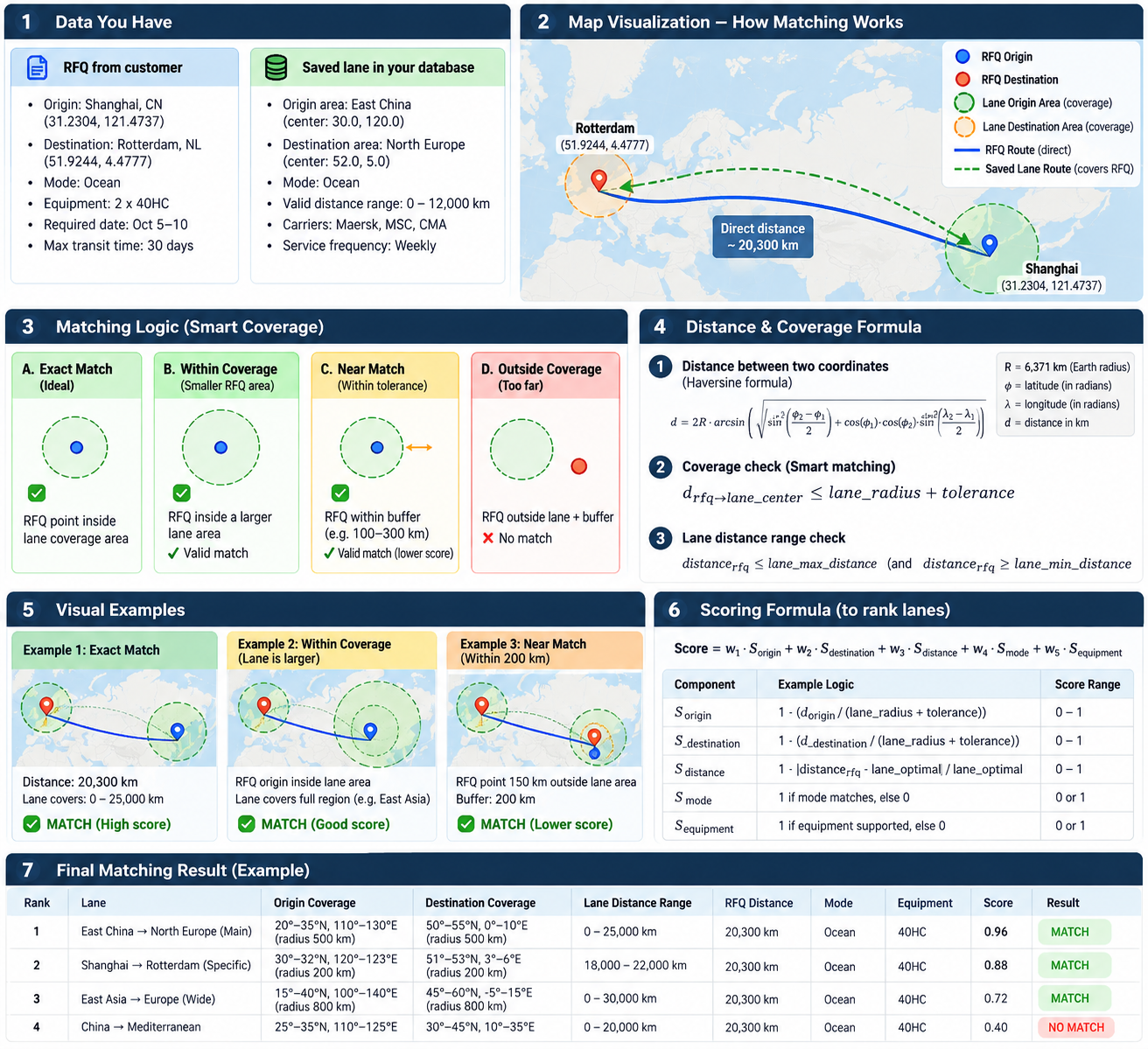
We took a different route: geography. Every RFQ origin and destination is geocoded into coordinates — Shanghai becomes (31.2304, 121.4737). Every saved lane becomes two coverage areas: an origin region and a destination region, each with a center, a radius, a distance range, a mode, and equipment it can carry.
The match, step by step
- Distance. The RFQ point is measured against each coverage center with the Haversine formula — the great-circle distance on a sphere, R = 6,371 km. No planar approximations; freight crosses hemispheres.
- Coverage. A point inside the lane’s radius is an exact match. Outside the radius but inside radius + tolerance (typically 100–300 km) is a near match — scored lower, still honest.
- Range check. The RFQ’s own distance must sit inside the lane’s min–max window. A regional lane that covers 0–12,000 km does not pretend to quote a trans-Pacific haul.
- Mode and equipment. Ocean vs. truck, 40HC vs. flat rack — binary terms, either supported or not.
A score you can audit
Candidates are ranked with a weighted sum — w₁·S_origin + w₂·S_destination + w₃·S_distance + w₄·S_mode + w₅·S_equipment — where each term is a visible 0–1 value. When a forwarder asks “why this lane?”, the answer is five numbers, not a shrug.
When nothing matches
The score’s job includes saying no. An RFQ that falls outside every corridor is not stretched to fit the nearest one — it is marked uncovered and handed to the Scout, which searches the market for real carriers and sends tracked spot RFQs. A “no match” is a routing decision, not a failure.
That is the difference between quoting from memory and quoting from geometry: the system knows the shape of your network, and it knows where that shape ends.